
Managing Risk in Dense Urban Transit Environments
Urban transit systems operate at the heart of cities, moving high passenger volumes on tightly scheduled, safety-critical networks. Cybersecurity must protect OT across the network without disrupting service, safety, or the passenger experience.
The Main Challenges in Securing Urban Transit OT
Highly automated and tightly coupled operations
Urban transit systems depend on automation to maintain short headways and reliable service. Technologies such as CBTC, automatic train operation (ATO), and centralized supervision via Automatic Train Supervision (ATS) increase capacity and efficiency, but also create strong interdependencies across the network. A cyber issue in one subsystem can quickly propagate, making system-wide visibility and early detection essential.

Expanded exposure in public and shared environments
Urban transit OT extends into publicly accessible stations, involving Ticket Vending Machines (TVM), turnstiles, and interfaces with municipal systems. This proximity to public networks, contractors, and third parties expands the attack surface and complicates segmentation, monitoring, and access control.
Service disruption rapidly becomes a safety concern
In dense urban networks, even minor disruptions can escalate quickly into platform crowding, constrained evacuation routes, and cascading impacts across interconnected lines. Security response must prioritize controlled degradation and safe throughput, ensuring issues are contained without destabilizing the network or placing passengers at risk.
How CylusOne Empowers Security Operations in Urban Transit
Understanding the Urban Transit OT Environment
CylusOne provides unified visibility across urban transit OT environments, continuously discovering assets and monitoring communications across control centers, signaling, stations, depots, and onboard systems. By understanding CBTC-based control architectures common to both metro and light rail, including VOBC-ZS control loops, ATS supervision, and DCS backbones, CylusOne builds an operational picture that reflects how automated urban networks actually behave, helping teams identify risk before it affects service.
Focused Detection for CBTC-Driven Transit
CylusOne applies rail-specific detection tuned to urban transit operations. We focus on behavior that matters in highly automated environments, such as Zone Controller (ZC) interactions. By highlighting unexpected device communications, unusual control-path activity, and deviations from line- or segment-specific patterns, it helps teams distinguish genuine cyber risk from routine operational variability such as peak-hour adjustments, timetable changes, or maintenance activity.
Containing Risk Without Disrupting Passengers
CylusOne supports a response that fits urban transit realities: fast triage, coordinated decision-making, and containment options aligned with degraded-mode operations, preserving safe headways and restoring service. By enabling security, operations, and engineering teams to work from the same operational context, CylusOne helps operators isolate risk precisely, preserve safe service levels, and restore normal operations with minimal passenger impact.
Securing All Rail-Specific Systems



Extended Resources
The Rail Cybersecurity Landscape in 2025
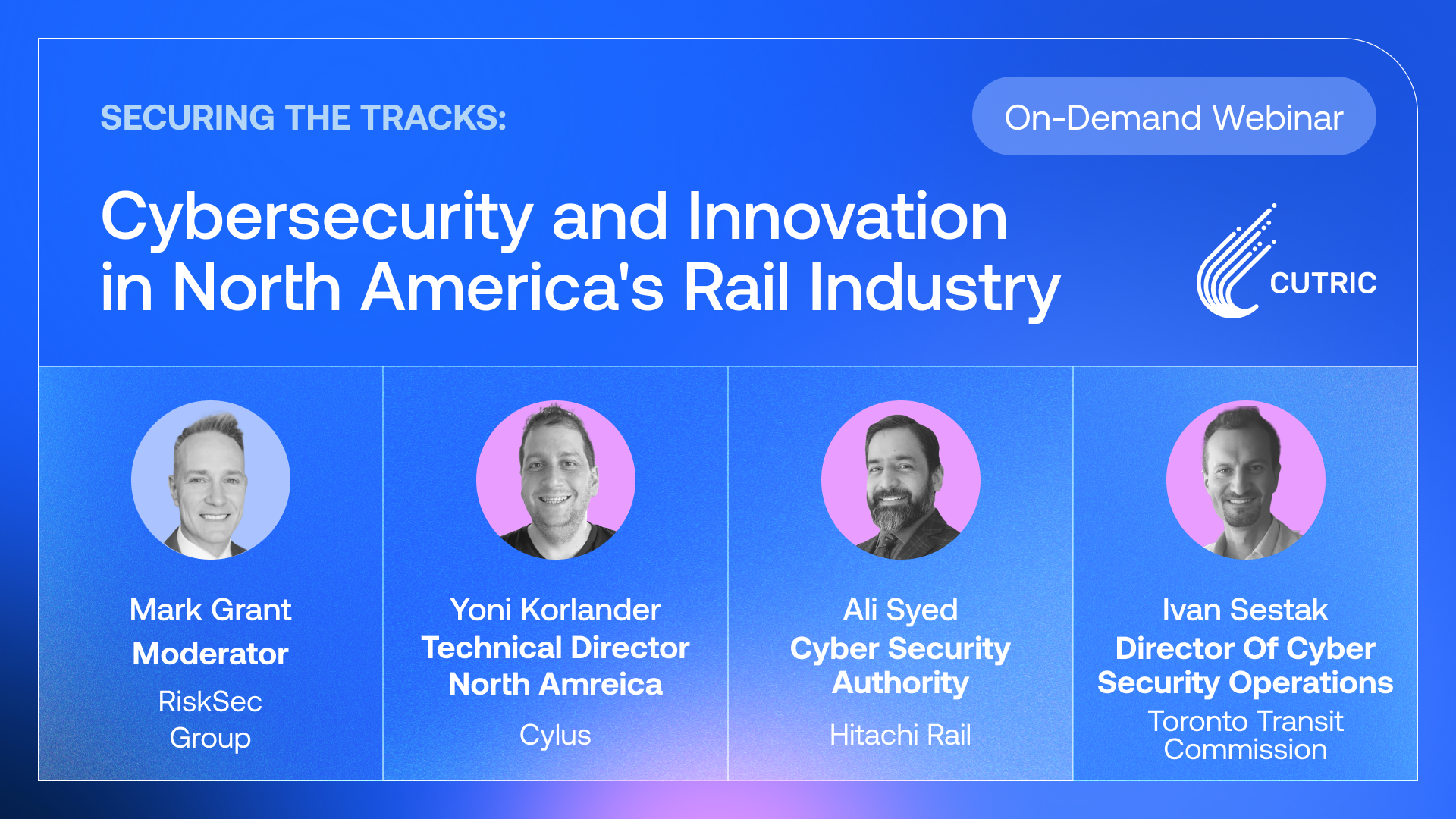
Securing the Tracks: Cybersecurity and Innovation in North America's Rail Industry

Cylus: Cybersecurity Purpose-Built for Rail